Durable Boot Struts for Safe and Smooth Lift Support

Stable Support

Designed to securely hold the boot lid open, preventing sudden slams and ensuring safety during loading or unloading.

Smooth Operation

Provides controlled lifting and closing action, delivering a seamless user experience every time you access the trunk.

Durability & Reliability

Built to withstand frequent use and changing conditions, offering long-lasting performance without frequent replacements.

Boot struts, including boot lid struts and car boot gas springs, are essential components designed to make opening and holding the trunk of a vehicle both safe and effortless. They use hydraulic or gas-filled pressure to provide the necessary lifting force, ensuring that even heavy boot lids can be raised smoothly without requiring extra effort. This mechanism not only improves user convenience but also reduces the risk of injury or strain caused by manually lifting a heavy trunk.

In addition to lifting support, boot lid struts play a key role in keeping the boot lid securely in place once opened. By preventing sudden or accidental closures, boot gas struts protect both the user and the vehicle’s bodywork from potential damage. With reliable boot struts, drivers and passengers can enjoy stable, efficient, and worry-free access to the storage compartment, whether for daily use or long-distance travel.

Boot Struts

Tired of heavy or dropping boot lids? GASTAC Boot Struts make every lift smooth, stable, and safe. Designed to replace weak or worn-out struts, they hold your boot securely open without sudden drops or extra effort. Built with durable materials and reliable gas pressure, GASTAC boot lid gas struts deliver long-lasting performance and effortless convenience for your vehicle’s boot.
Audi TT Boot Struts

Audi TT Boot Struts

Audi A5 Boot Struts

Audi A5 Boot Struts

Hyundai I30 Boot Struts

Hyundai I30 Boot Struts

Ford Fiesta Boot Struts

Ford Fiesta Boot Struts

FG Falcon Boot Struts

FG Falcon Boot Struts

Mercedes A Class Boot Struts

Mercedes A Class Boot Struts

Mercedes SLK Boot Struts

Mercedes SLK Boot Struts

Nissan Qashgai Boot Struts

Nissan Qashqai Boot Struts

Nissan Micra Boot Struts

Nissan Micra Boot Struts

Nissan X Trail Boot Struts

Nissan X Trail Boot Struts

Nissan Qashgai J11 Boot Struts

Nissan Qashqai J11 Boot Struts

Qashqai Boot Struts

Qashqai Boot Struts

Golf MK7 Automatic Boot Struts

Golf MK7 Automatic Boot Struts

MK5 Golf Boot Struts

MK5 Golf Boot Struts

Skoda Octavia Boot Struts

Skoda Octavia Boot Struts

Skoda Fabia Boot Struts

Skoda Fabia Boot Struts

Volvo V50 Boot Struts

Volvo V50 Boot Struts

Volvo XC60 Boot Struts

Volvo XC60 Boot Struts

Suzuki Vitara Boot Struts

Suzuki Vitara Boot Struts

Toyota Yaris Boot Struts

Toyota Yaris Boot Struts

Toyota Runx Boot Struts

Toyota Runx Boot Struts

Boot Struts Vauxhall Corsa

Boot Struts Vauxhall Corsa

How to Measure and Choose the Right Boot Struts

Choosing the correct gas strut is more than just matching a car model—it requires precise dimensional accuracy to ensure safety and smooth operation. A strut with the wrong length or force rating can damage your boot hinges or fail to hold the lid open. To help you get the perfect fit the first time, taking the parameters in the diagram below as an example, use it as a visual guide and verify your old part against the 4 critical measurements below.
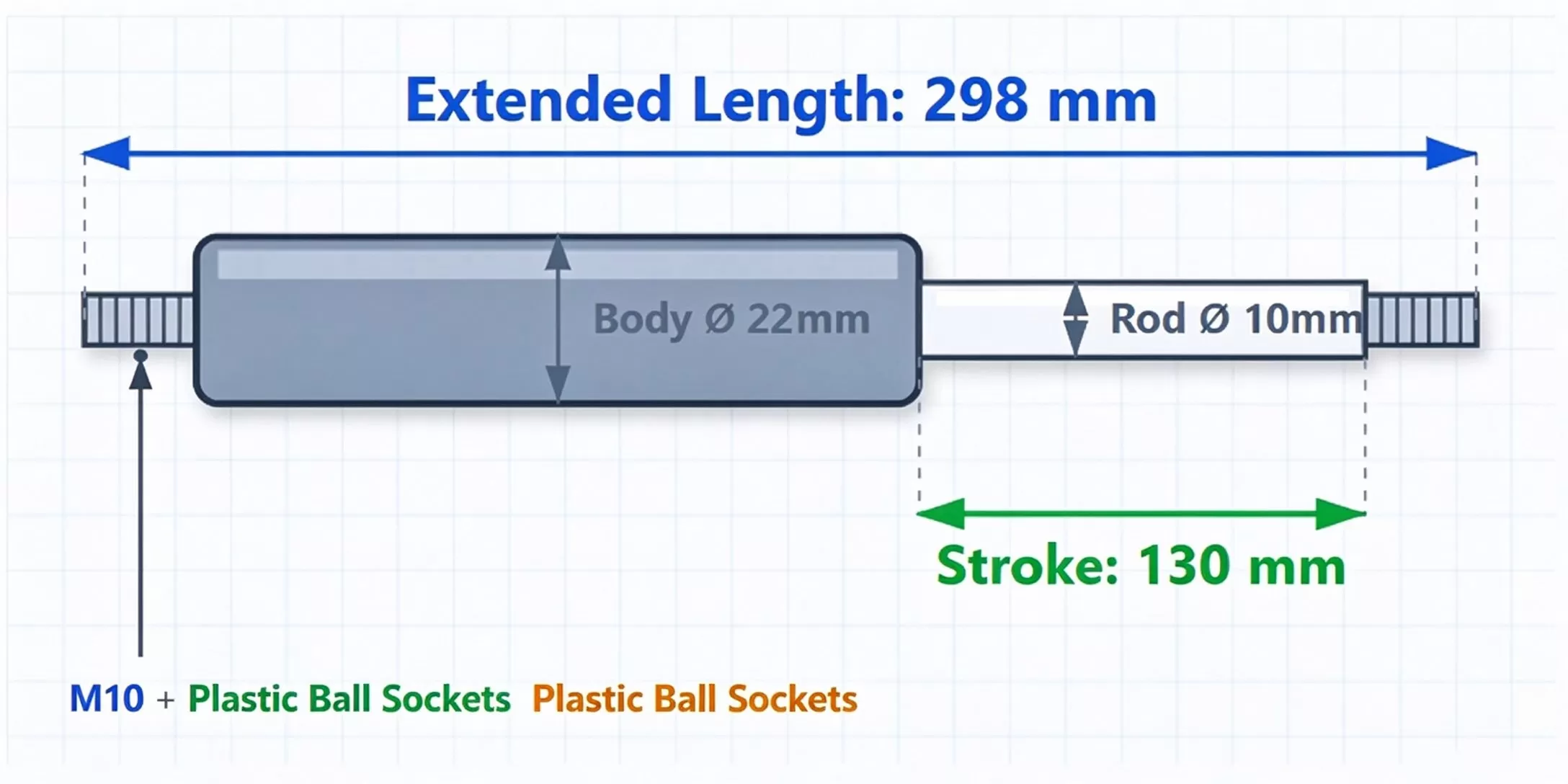
  • 1. Extended Length: Measure centre-to-centre of the mounting points when fully open (e.g., 298 mm). Never measure just the cylinder body.

  • 2. Stroke Length: The total travel distance of the piston rod (e.g., 130 mm). Ensure it matches to allow full boot opening.

  • 3. Body & Rod Diameter: Cylinder body (Ø 22 mm) and piston rod (Ø 10 mm). These determine load capacity and durability.

  • 4. End Fittings: Check both ends. Most cars use M10 studs with plastic ball sockets, but some SUVs may vary.

Please note: The pressure rating (N) and OE number are usually stamped directly on the metal tube of your car boot strut. If the label is lost or worn away, please contact our professionals to help you determine the correct replacement.

Is It Time to Replace Your Boot Struts?

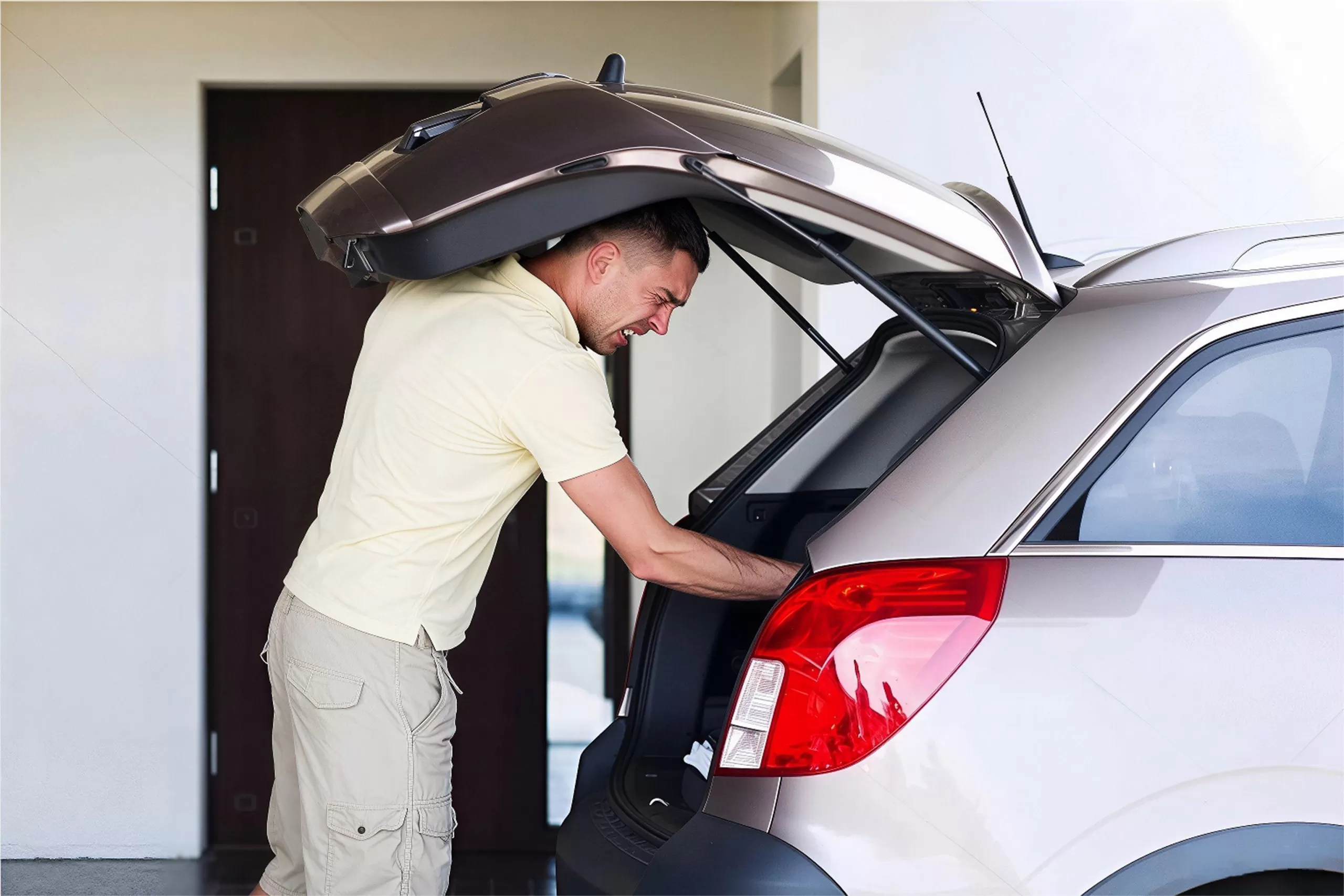
As a mechanical component, a boot gas strut is subject to continuous wear. Daily use—frequent opening, closing, and bearing the weight of the lid—accelerates the degradation of internal seals and causes gradual gas pressure loss. A failing strut is not just an inconvenience; it poses a real safety hazard and can damage your vehicle’s hinges. Watch for these critical warning signs:
Signs of a failing boot strut
  • Inability to Hold the Weight: The boot lid won’t stay fully open, drops slowly, or slams shut unexpectedly, creating a risk of head injury.
  • Excessive Lifting Effort: You have to use significant muscle power to open the lid because the gas assist has completely diminished.
  • Oil Leaks on the Piston Rod: Visible oil or grease means the internal seal has ruptured, causing the nitrogen gas to leak out.
  • Uneven Operation: One side drops faster than the other. This mismatched pressure twists the boot lid and puts severe stress on the hinges.
  • Physical Damage: The cylinder is heavily corroded, or the piston rod has bent. Never attempt to repair a damaged gas strut yourself.

Safety & Installation Precautions

  • High-Pressure Hazard: Boot gas struts contain highly pressurized nitrogen gas. Never puncture, heat, or attempt to disassemble a gas strut, as it may explode.
  • Replace in Pairs: Always replace both left and right struts at the same time. Mixing a new strut with a worn one creates uneven pressure, causing the boot lid to twist and damage the hinges.
  • Do Not Use as an End-Stop: Gas struts are designed to assist lifting and hold the lid, but they must never be used to mechanically limit the maximum opening angle of the boot lid.
  • No Lateral Force: Gas struts are designed for linear compression only. Avoid bending or applying side loads to the piston rod during installation, as this will damage the internal seal.
  • Correct Orientation: For optimal seal lubrication and a longer lifespan, install the strut with the cylinder body pointing downward (piston rod pointing upward) when the boot is closed. (Note: This does not apply to all models; always match the original position).
  • Power Tailgates: Standard gas struts are not a direct substitute for automatic or power tailgate actuators. Confirm compatibility before purchasing.

Boot Struts Advantages

Open your boot with just one hand, no strain or struggle.

Prevents sudden closures and protects your hands.

Designed to match your car model precisely.

Built for 100,000+ cycles, ideal for any weather.

DIY-friendly, replace in minutes with simple tools.

Car Boot Shock Applications

Frequently Asked Questions

No. Standard gas struts are designed for manual boot lids only. Vehicles with automatic or power tailgates require specific electronic actuators or specialized electric struts. Attempting to install standard gas struts on a power tailgate can damage the vehicle’s electrical system or the strut itself. Please contact us with your car model to verify the correct replacement.

Our 3-year warranty covers manufacturing defects, internal seal failures, and abnormal gas pressure loss under normal daily use. It does not cover physical damage caused by accidents or improper installation. To claim a warranty, simply provide your order number and a short video/photo showing the issue. Our support team will arrange a free replacement pair immediately.

Absolutely. As a leading gas spring manufacturer with over 20 years of experience, we offer full OEM/ODM services. Whether you need a specific Newton force for a modified vehicle, custom lengths, or unique end fittings, our engineering team can manufacture them to your exact specifications. Contact us to discuss your requirements.

A clicking noise usually means the retaining clip hasn’t fully seated on the ball stud. Push the strut end firmly onto the ball until you hear a distinct “click”. If you hear a squeak, it indicates friction between the plastic socket and the metal ball. Apply a small amount of silicone grease to the ball studs—never use standard oils or WD-40, as they degrade the plastic socket material.

We strongly recommend replacing both boot struts simultaneously. If you pair a brand-new strut with an old, worn one, the pressure will be unbalanced. This uneven force will cause the boot lid to twist slightly every time you open or close it. Over time, this torsion will severely damage your vehicle’s hinges and cause the new strut to fail prematurely.

A very thin film of oil on the piston rod is completely normal and necessary. It is not a leak, but rather the internal lubrication required to keep the rubber seal supple and prevent it from drying out. As long as the strut holds the boot lid up firmly and the oil is not dripping or pooling, the strut is functioning perfectly.